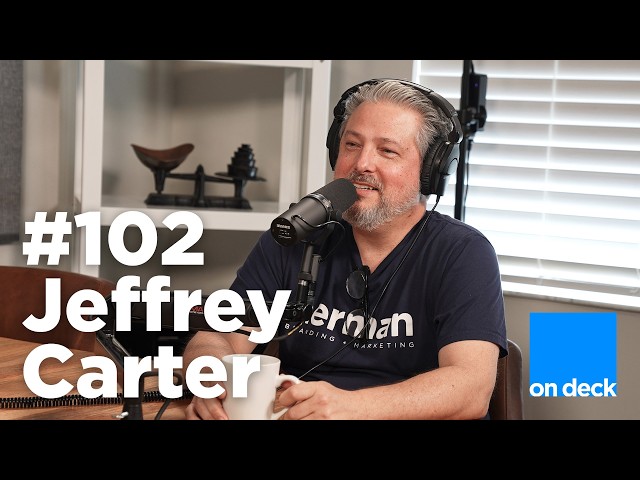
Jeffrey Carter: Brand Strategy, Advertising, and Finding the Truth in a Brand


LISTEN OR WATCH ON



EPISODE OVERVIEW
KEY TAKEAWAYS



What does Jeffrey Carter say about results-driven creativity?
What does Jeffrey Carter mean by 'brand truth'?
Why does Jeffrey Carter say creative outlets matter for business leaders?
EPISODE transcript
Chris Herman: Okay. Hello everybody. What would a podcast or interview show be without some intro music? So, for now, we'll call this the intro music. Let the show begin. Jeffrey Carter. Cheers.
Jeffrey Carter: Cheers.
Chris Herman: Welcome.
Jeffrey Carter: Thank you. Glad to be here.
Chris Herman: Okay. So, I feel that it would be inappropriate to start anywhere else other than I have a vision in my mind. So, we're going to go back, I don't know, 28 years, 27, 28. We're going to go back a long way.
Jeffrey Carter: Wow.
Chris Herman: So, my recollection... Okay. So when I started at Zimmerman, I was on Pat's team and then slowly I was able to move out of the little office that Pat was in and kind of take over what was almost like an entryway foyer area to the account services department off the main hallway. Right.
Jeffrey Carter: Yes.
Chris Herman: So, I had a desk there with my team and so I could look out on the main walkway on the third floor that went to the front door of Zimmerman.
Jeffrey Carter: That's right.
Chris Herman: And I can remember sitting there seeing you walking in and then of course, you know, through the course of the day we would be back and forth, but you know, you'd go in the front door, go to the left into the creative department.
Jeffrey Carter: Yes.
Chris Herman: And then if I recall correctly initially you were in like you kind of went around to the left and there was an office to the left.
Jeffrey Carter: That's right.
Chris Herman: And then there was another office that later John was in. But when you first started, you were in the office to the left with two other guys.
Jeffrey Carter: No, with one other.
Chris Herman: With one other guy.
Jeffrey Carter: Yes, with one other. With Brian Franklin.
Chris Herman: Okay. With Brian Franklin. Okay. So, what year was it that you started at Zimmerman?
Jeffrey Carter: It would have been early 1997 because I was—and the only reason I remember that year is because I was still in college. I hadn't yet graduated because I had miscalculated the number of credits I had needed to graduate and I was a course shy. So, I had to miss my what would have been my regular graduation and I had to stay an additional semester to complete one course.
Chris Herman: Oh, okay.
Jeffrey Carter: And then, yeah, I remember when I started at Zimmerman, I was still in school. I didn't have my degree actually until May.
Chris Herman: Did they know that?
Jeffrey Carter: Yeah, they knew that. Yeah, because they did make an accommodation where, you know, I was working full-time, but I had to go to class. So, they made an accommodation so I could attend the one class I had to attend.
Chris Herman: Okay. So, you started there then a few months before I did because I started in June or July of 1997. And so you were already working there and you were working as a copywriter at the time, right?
Jeffrey Carter: A junior copywriter. Uh, and funny enough, I didn't have any idea what it was when I went to apply for the job. You know, this is pre-Mad Men. The ins and outs of the inside baseball of what jobs there were inside of an agency weren't exactly widely available. I just knew it had the word writer in it, and that's what I wanted to be.
Chris Herman: It's interesting. So, we both are in or approaching our 29th year in this career. Because we both start at the same time. So, that's where I wanted to start off because we've discussed this many times and we'll at some point in time kind of fast forward to where we're at now. But we both have spoken a lot together about what kind of an impact working at Zimmerman had on us and our career and, you know, without a doubt it made a very, very strong impression on both of us for similar and different reasons. But before we even get to that, I'm just curious what, you know, you having been born and raised in Florida, what was it as a young boy, young man that led you in the direction of wanting to work at an advertising agency?
Jeffrey Carter: Well, from a very young age, I had always found ways to express my creativity, primarily through writing in different avenues. Whether it be writing little skits for myself and my friends to perform. I remember a good friend of mine, we had a talk show.
Chris Herman: No way.
Jeffrey Carter: Yeah. That we would fully write and prepare that had guests, you know, someone would be the host and then someone would be the guest star and it would be pretty much written out as a script. We'd look at it beforehand, kind of try to memorize as much as we could, and then we'd go on and do it. And then in school, you know, I would write plays. I was always a really good English student. I was an avid reader from a super young age. My mom, thank God for public libraries, would take me to the library it seems like every two weeks or so and I would get a stack of books. My mother was an avid reader, so she passed that on to me.
Chris Herman: Okay.
Jeffrey Carter: So I was an avid reader and I would always find ways to express my creativity through writing.
Chris Herman: But what was it about right? I mean I guess if you start off as an avid reader though the joy is that you're reading the written word. And so was it just a natural extension or expression of that, like it just made sense to start writing because you enjoyed reading?
Jeffrey Carter: Maybe because I knew that writing had an impact on me. So when I would read something, you know, I would feel that emotional escape. And I knew that writing could have an impact and I guess in my desire to have an impact, I knew that the written word was a way to do that.
Chris Herman: So did you pursue that all through school and into college?
Jeffrey Carter: So I did have moments where I dallied in other aspects of things I liked. That is to say I became a huge drama nerd.
Chris Herman: Right.
Jeffrey Carter: Yeah. And I was in drama, theater classes I believe starting in junior high which was also a natural extension of me. I was always the class clown. I was always getting called out, sent to the principal's office for making off-hand remarks and jokes and trying to make people laugh, right? So, theater just seemed like a natural way to express myself. Then, I became very involved in theater. I went to New World School of the Arts for drama which I didn't complete, but that's another story. And so I did dally with that. And then of course music, right? So after I got into listening to Metallica and all the big bands of that time, I wanted to emulate those guys. So you know, I picked up a guitar and started learning to play guitar. And that seemed like a natural bridge from theater, right? You're already on the stage, already comfortable with being in front of people, just do it musically. So, there was a time there where I was trying to figure out which way I was going to go. And I remember my theater teacher got really mad with me when we were going to be in the talent show as our band, Armageddon. Doing two Metallica songs, of course.
Chris Herman: Right.
Jeffrey Carter: Yeah. Doing "Welcome Home (Sanitarium)" and "For Whom the Bell Tolls."
Chris Herman: Okay.
Jeffrey Carter: Uh, got super mad that it was taking away so much, diverting so much of my energy and attention away from actual drama, from acting, to which he got me with the old phrase, "Do you want to be a jack of all trades or a master of one?" And I said I'll be a jack of all trades I guess because that's what I like. I like a little bit of all this stuff. So yeah, I think that there was a time primarily in junior high where I was trying to discover which way I wanted to go. And then I think in high school I really cemented on, after my failed stint at New World School of the Arts, I think I really focused on, "Okay, I want to be a writer." Or if not a writer, have some aspect of my life focused around writing. So I really began to focus, really got into critical reading, you know, not just reading to read, but reading to think about it and looking at the critiques of reading and really trying to understand all the different layers of a work and that's what I ended up going to college for. You know, I was an English major in college and then from there to advertising.
Chris Herman: So okay, so that to me presents a very funny sort of dichotomy, right? Because what you've described is a classical literature background with a strong focus on writing and drama and performance which is serious stuff. And then you find yourself at Zimmerman and at that time it was the retail car business. So now you find yourself in an environment where you have developed a curiosity and a passion for things of literature and writing and thoughtfulness and deep thought. And now you have to distill that into, you know, "Mitsubishi Eclipse $99 a month." "Get down here right now." "Buy this car today." How did that feel when those two worlds collided when you're going, "Okay, now I have to use my skill set for this"?
Jeffrey Carter: Yeah, definitely a learning curve, right? A huge learning curve. Um, you know, they always say for advertising copy especially, like you can't be afraid to kill your babies. You know, whatever you put out could be changed at a moment's notice.
Chris Herman: Yeah.
Jeffrey Carter: And you know what it taught me was writing not just to write, but writing for a purpose and writing with psychology in mind because a big part of advertising is psychology and understanding the consumer and who your audience is. Huge learning curve.
Chris Herman: Yeah, you know, when I think about that I'm immediately... I think, you know, there's sort of two worlds of advertising. There was the standard traditional big agency world that was very focused on—it's not that they weren't focused on results but it seemed that a lot of the work was very focused on doing great work for the recognition of doing the great work. So you had all these advertising awards shows and Clios, and everybody submitting their work for an award like it was a movie for the Oscars or a song for the Grammys. And the among the many things that Jordan taught us was that the awards and that's that's [ __ ]. The focus of what we were taught to do and what we were doing and quite frankly what we still do was you're trying to generate a result. Which is why like when I joke about sort of the dichotomy of your literature and English background to the sort of the stark brute force reality of writing retail automotive copy, in many ways you can't start in a better place because everything distills down to what we were being taught was you've got to create something that gets that person to go to that place to buy something in like two days, today.
Jeffrey Carter: Today. Yeah. Right now would absolutely be preferable. And it worked.
Chris Herman: Yeah.
Jeffrey Carter: And what I think people—I mean back then, so we're talking almost 30 years ago—a large part of a junior copywriter's role was tedium in inputting the statistics for the car, right? Like whether it had AC, what kind of drive—four-wheel drive, front-wheel drive, rear-wheel drive, power windows, whether it has a CD player.
Chris Herman: I forgot that was as a junior copywriter, you were entering all the information for the prints manually.
Jeffrey Carter: Yeah, manually. The VIN numbers, the price, the everything. So a lot of it was almost like database management, not so much creative writing.
Chris Herman: Well, it was tedious and so much you were like a lot of just poor handwriting coming from the dealer that you had to interpret.
Jeffrey Carter: They'd fax it over. Yeah. The AE would give it to us. It would come in the job folder and then you had to input it and it was, you know, 20 sheets of data entry for each vehicle. A '97, you know, Toyota Camry.
Chris Herman: I totally forgot about that. That was the because you didn't graduate to script writing until you had gone through a lot of that, right? And showed some promise to get into the script. You started off in print.
Jeffrey Carter: Yeah. You cut your teeth on print and that taught me a lot about interacting with the other creatives, right? So the art department, you learn to interact with them and what each of their personalities is like and how to give direction, right? Because it starts with the copywriter in that scenario. It's a blank sheet and then you have to come up with the headline and you're basically giving art direction as a person who's never done it before. And the AE would pitch in, the client would pitch in and there'd be a theme but you would need to translate all of these disparate ideas, which is still a big part of copywriting—distilling them into something that first of all a designer can understand and execute on, and then getting that back, reading it over, and saying, "Does this align with what we actually want to do?" So you're kind of the gatekeeper between design and the account side, because it goes to you before it goes to them.
Chris Herman: Now, how often did you even see the final product? Or was it a lot of times like you put in all this information and then poof?
Jeffrey Carter: Yeah. A lot of times it was down. And then you didn't know whether it did well, like whether it sucked.
Chris Herman: For me, when I think back on those times—a zillion great memories and funny stories and lessons learned—I will say that definitively during that window of time, let's call it the late '90s, early 2000s, advertising for car dealers, it worked. There was no lack of clarity on whether your idea worked or it didn't because the nature of the way we operated at Zimmerman, which was largely media-driven, meant that almost all the dealerships had a significant radio buy.
Jeffrey Carter: It was a lot of radio.
Chris Herman: Lot of radio because that was where a dealership could afford reach and frequency. People are in their cars commuting. And so most stores had a significant radio buy. And so what we did creatively on those radio commercials—you knew if it worked. And that was what was so cool about it—is that you knew. Of course there was a lot of print ads and they worked at the time. But with the creative theme and what the messages were and what the hooks were, we knew. As AEs, we had to make the calls all weekend to the dealers to get the numbers. And then we were at Zimmerman at 7:00 or 7:30 on Monday morning with Jordan and Terry and Pat, and we had to go through all the numbers and talk about what worked and what didn't. You always knew—if the creative was strong and aggressive, the dealership sold cars. And if it wasn't, they didn't. And if you fast forward to now, almost 30 years later, digital was supposed to make everything so much more trackable and you could understand what was working and what wasn't because everything was directly connected into the website. And that turned out to be such a fallacy, right? And digital in many ways was sold on the back of, "Well, you don't know if traditional is working or not, because there's no way to accurately measure it other than a sales manager tracking the ups into the store and whether they had traffic or not." But I would argue that that intangible tracking method of traditional at that time was so much easier to see what worked.
Jeffrey Carter: Mhm.
Chris Herman: Because if we ran a great campaign, aggressive offers, a good spot, they sold cars. They had traffic, they sold cars, and you knew it because it was a weekend business. Now it's a little more muddy to determine what works. So, it's just funny that the old way that was supposed to be cloudy and mysterious was much more clear in terms of the effectiveness and I would argue it was a lot more fun. The nature of the way the business was during those times—under pressure to come up with ideas, the deadlines, the energy of what it took to make that happen—was exciting and fun, especially as a young person starting your career.
Jeffrey Carter: Yeah, for certain for a young person with a lot of energy who doesn't know any better. It's a heck of a lot of fun. Not a place for a family person. But you know what it did was it galvanized you into an effective writer, designer, or AE. It galvanized you into being a pretty good version of that thing. Especially from a writing perspective, you learned early on that cute didn't cut it.
Chris Herman: No.
Jeffrey Carter: Don't be cute. This isn't poetry. We're trying to achieve a result. So, being too clever by half just doesn't cut it.
Chris Herman: It's true.
Jeffrey Carter: And I think to your point, you know, you got to think back to the culture 30 years ago—it was a more monolithic culture with regards to radio. The attention wasn't as split as it is right now.
Chris Herman: Absolutely.
Jeffrey Carter: So, when we start talking about digital, then we're talking about the internet, phones, streaming, the music business shattering into a million pieces, and everybody getting into their own little niches and buckets and news feeds. Everybody's living in their own mini universe now. So I think that can be attributed to the muddiness, whereas back then almost everybody if you were in your car commuting was listening to the radio, or you read the newspaper, or you watched TV, or you got a direct mail piece. And like, that's all there was to it. And so yes, it was easier to make a bigger impression during that period of time.
Chris Herman: Yes. You know, and then we go through 10 or 15 years of the launch and advent of digital and how it has changed and evolved. And as somebody who has run an agency, we embraced digital and built a digital team off the back of a traditional agency. We were a traditional shop that adapted to digital, got pretty darn good at it, and then ultimately outsourced it to a partner just because that was a better fit for us. But we've been through that now. And it's interesting for me because I just came back from NADA, and I walk around and I see a lot of our old friends and coworkers and faces walking around. Those of us that went through that time period at Zimmerman, it made a strong impact. And there's a lot of the people that we worked with at that time that are still active in the business doing it now. So it definitely made a very strong impact on a lot of people. And here we are almost 30 years into our careers of advertising, marketing, branding, whatever we want to call it. And I've found a certain element has come full circle. As digital came on and expanded, each year it seemed to be a new channel that needed to be mastered—websites, then Google and search, social, third-party providers, and then how YouTube changed to video. So there was this constant process of evolving and adapting to new technologies or new delivery channels. A lot of time was invested learning how to utilize these new mediums effectively. And we're going through the same thing to some degree with AI. But the difference now I think is that we have gotten to a point where men and women like us who have been through what we've been through have a real opportunity to bring a particular thought process back into the mix. I've watched this with our clients as we came out of COVID and dealers started realizing they needed to get aggressive again. The things that we do at Herman and what we've done for all these years, there's still very much a need for that. There are not a lot of people that understand how to create a message that will work. And just because video is on your phone or not served through a traditional cable box, it's still the same thing.
Jeffrey Carter: Yeah.
Chris Herman: And it's come full circle to some degree and that's what makes it fun for us now.
Jeffrey Carter: Yeah. The principles of advertising don't change. We're still trying to get somebody to do something.
Chris Herman: Yeah, and I've always said it's like in a way that resonates with them. We're a matchmaker. You need something, you have that thing to sell, let's put you together and hopefully you guys can come to an agreement on some sort of transaction.
Jeffrey Carter: Yeah. That doesn't change.
Chris Herman: Medium, channels, delivery systems change, but the core doesn't. So, without making this a three-hour tour through the old days of Zimmerman, that's where our relationship began. That's where we started playing music together.
Jeffrey Carter: Yep.
Chris Herman: And really it is the music that kept us together all the years and brought us back together about coming up on about five years ago. Together with our good friend John Sheffield.
Jeffrey Carter: Mr. John, drummer extraordinaire.
Chris Herman: That's right. So, we worked together years ago at Zimmerman. We developed a shared love of music and playing music that we've managed to maintain and actually grow significantly over that period of time. To now we have a band, Lords of Rock, that we've been playing for five years now. And then through that, we've been able to reconnect from a work perspective. You helped us at an important time and now here you are and you're a part of the agency.
Jeffrey Carter: Yeah, we've come full circle. It's pretty amazing.
Chris Herman: Share some thoughts from your perspective on how this journey has unfolded because it's very interesting.
Jeffrey Carter: Yeah, it is. One thing I always connect with that time at Zimmerman is music sharing. I'll never forget you introduced me to DJ Shadow, who I'd never heard of in my life. You had Endtroducing..... on CD and you said, "You got to hear this." Because we were always playing music in our last office at old Zimmerman with myself, John, and Gregory Bruce. We had a big stereo system in there and you came in one day and said, "Man, you got to hear this DJ Shadow." I always connect that moment of a musical awakening with you sharing that with me. It happened multiple times—you gave me a couple of albums that I still listen to this day. And then, when we had first formed the band back then and then left Zimmerman, I don't think I'd picked up a guitar again until we reconnected, what was it, 2020 or 2021?
Chris Herman: I want to say it was '21. It will be five years in the fall.
Jeffrey Carter: Yeah. And we've gotten together a couple of times before then to get in the old rehearsal space and kind of kick the dust around. But I hadn't been working on my chops in that whole time. I wasn't a better musician when we got back together. But since then, I have become a much better musician. When I think back to what we were doing 30 years ago, I think to myself, "How did we even... we must have been terrible."
Chris Herman: Exactly. Like how did we even have the courage to get out in front of people, right? Because it had to have been awful.
Jeffrey Carter: We must have been awful. But even in the rehearsal room, the energy that the three of us have together is really something magical. We're always cheering each other on, antagonizing each other, getting each other hyped up, and there's nobody else in the room. We always play like we are putting on a show.
Chris Herman: It's true. When we rehearse, we give it everything. We leave exhausted, right? Not leaving anything on the stage even though there's no stage.
Jeffrey Carter: Yeah. We always had that, and when we reconnected, we had it again. And it was like, "Let's not lose this. This is too good." And we got a lot of positive feedback from people when we eventually did play for anyone. We rehearsed for two years before we even got out there.
Chris Herman: Well, you know, and during that period of time, starting around '21 or '22, that was an extremely challenging time for the agency because we had gone through COVID. Then the chip crisis put the brakes on the retail automotive business from the perspective of needing any meaningful marketing support other than the basics. It was like nobody really needed us. At the time we were inhabiting a big beautiful 5,000 square foot space and I had 25 or 26 employees and every day there was just some new bad news. But this journey of building a podcast studio, an audio production studio, a recording studio—all that started about five or five and a half years ago. Initially, it was like, "What am I going to do with all this space?" So we'll do a podcast and then we started playing music. But through that period of time, it was a really tough time for the business. And us playing music together and having that creative outlet during a really challenging time was a make-or-break for me. I don't know how I would have been able to go through that transition watching everything that I had built over 13 years crumbling apart and getting to the point where I don't know if we're even going to be able to keep the shop open. Fortunately, I never went to go get a job. And during that period of time, the band was my common creative denominator that helped keep me focused on something that felt like it was building. It filled the hole that was being created as the industry shifted and my agency was very close to being non-viable. And it was you, sir, that lent such a meaningful helping hand. You were at Bluegreen at the time and you helped us get the opportunity for us to film a bunch of footage for Bluegreen Properties. Richard wouldn't be sitting right over there if it wasn't for that. You put that lifeline into the agency and the faith you placed in us to be able to go do that work... I can't ever thank you enough.
Jeffrey Carter: I think you just did. And I'd seen some of the work prior and I was like, "These guys are the real deal." You had the talent, the will, the drive, the right people in the right place. And when I saw the stuff you guys were producing, I was like, "Well, this is top-shelf stuff."
Chris Herman: It was such a lifeline and it was a meaningful experience that showed us we had the capability as a team to go out and do things that were non-automotive. Bluegreen was a huge time share vacation property company with properties all over the U.S. We went and shot fantastic footage in St. Augustine, Tennessee, and Orlando. It turned out great and more importantly it showed us that we could be more than an automotive shop. Retail automotive will always be a cornerstone and it is still the majority of what we do, but we will always be looking into non-retail automotive verticals because we've developed a skill set and a crew that can do that. And that all goes back to you taking a chance on us at that time. I can never thank you enough for that.
Jeffrey Carter: I'm glad it worked out. Ever since we reconnected, I think I was trying to discover ways to be a part of the Herman world.
Chris Herman: Well, you succeeded. Over the course of the last year or so, you have slowly transitioned into our world together and here we are sitting here as co-workers, team members, and crew members. It's funny because people ask, "What's Jeff's title?" He doesn't have one yet. But largely because of you, we're about to go through another brand refinement. A large part of that refining process has to do with the skill set that you bring to the table. At this point, I would say you are a bit of a jack of all trades.
Jeffrey Carter: Story of my life.
Chris Herman: Yes, and it's worked. But you're leading brand strategy and client relationships. You brought in some new business—the amount of people that have come into my world that actually were able to bring in an account is slim to none. What you bring is going to be a huge part of what we are moving forward. As we've moved from being an advertising agency to a digital marketing company, really what we bring to the table is largely creative. It goes back to that understanding of how to write, how to craft a story, how to develop a brand for a business, how to put together a strategy so that brand is advertised and marketed out in the world to find the right consumers. Now we're getting to be able to say, "You know what, we don't need to expend energy in areas that other people are really good at when we can focus our energy on areas where we're really good." It seemed to be a disease that a lot of companies fell prey to in the late 2000s and early 2010s where they spent so much time and energy trying to be great at so many different things, especially in the digital sphere. "You got to have a blog, you're going to update it every day, who's on social every day, SEO..." It just became a grind. I'm guilty of that. I did not listen to my dad, who was always like, "Just find the person that is great at this and let them figure it out."
Jeffrey Carter: And I think they had to learn that lesson. "Do we even have to be doing this just because everybody else is?"
Chris Herman: No, but it took me a long time. It was failure that made me go, "Okay, maybe we should just stop trying to be this because we're not great. We're really great at this, let's focus on this." I wanted Herman to be a full-service shop that could bring everything to the table. But especially with digital, it becomes unmanageable. Digital in itself opens up so many opportunities for mistakes. I remember a client saying, "When you go to a restaurant and the fork is not clean, you wonder what the bathroom's like, and then what the kitchen's like." He was telling me that's what he was experiencing with me on the digital front. I hated those conversations. After a while, I was just like, "No, let's just have somebody who's great at that do that and let's focus on what we're really good at." By default, there's not a lot of people that do what we do. We have a particular niche and we're good at it. Collectively as a team right now, we're really well-positioned. We've made it through a challenging period of time and come out significantly stronger and better-equipped. If somebody were to ask you at this point in time, what is it that you do and what is your specialty? What would you tell them?
Jeffrey Carter: I would say my specialty right now is brand story and strategy. Really delving into branding as a subject—reading a lot of books and online stuff about the psychology of it and different methodologies to achieve a brand that really stands out and that's true to itself. My strength has always been writing—understanding the audience. Who are we talking to? What do they need? And then writing something that solves that problem for them.
Chris Herman: That's where we're really focused, right? Helping companies develop and establish the brand story. I think there's some people that probably think that's not that important.
Jeffrey Carter: Yeah, I would agree with that.
Chris Herman: I can't say enough about how important a brand is. Not only for the company to have a brand story, but for the company to make sure that story is not just communicated via marketing, but that it is lived and experienced inside the company as well.
Jeffrey Carter: Which is usually where it comes from. Companies are an organism built of people. From that culture evolves the brand. What you're trying to do as part of the brand exercise is figure out what is unique about this company from a cultural perspective that is true. Every company has a truth and they have a hard time sometimes putting it into words and codifying it. So, how do we get it into one message? Once you figure out what that truth is, there are consumers that will engage with that truth because it aligns with their values and helps them become the heroes of their own stories.
Chris Herman: I couldn't agree more. When I used to go pitch business, I had a presentation called the "12 Steps to Success." Number one was always "Who are you?" What is the DNA of your business? It always comes down to the culture. In the retail automotive world, that could be a high-volume, "wham bam" dealership. That is the culture, and that's okay. Be that—be the high-volume, huge discount, slightly edgy dealership. But if your thing is more about your people, then share that. It has to go back to the core of the DNA. I've watched so many cool companies that had an incredible brand identity and a cool culture, and that company sold to a bigger entity and you just watch it all get lost in translation. Everything that was special is now gone and it's just become a bigger piece of a larger faceless entity. It happens with rapid expansion. Think about food chains that started off with such strong cultures and quality ingredients, and then they become huge and all of a sudden there's a huge drop because it's hard to maintain culture across that many people.
Jeffrey Carter: Companies are made of people.
Chris Herman: I believe in capitalism and anybody's right to make as much money as they possibly can. I understand there is top-down pressure in the corporate and investment world for businesses to have growth. Companies can't always just grow based on their current products, which is why these acquisitions are necessary to meet growth expectations. We've all seen clothing brands or technology companies get acquired and you just see the quality vanish. When I think of brands that have been able to maintain their identity and integrity, I actually think of bands. AC/DC is AC/DC. Metallica is Metallica. Paul McCartney is Paul McCartney. The ones that just resist and stay in their lane and really just keep banging out their thing... they're still doing it. You look at the Rolling Stones—that is a corporation 100%. Taylor Swift is a corporation. But a lot of them have been able to maintain control of their brand for a long period of time. Some of the greatest bands also recognized there's a time to put an end to this. The Police were a great band, and they just went out on top. Essentially, we're talking about brands or companies—staying committed to guiding that for the long term and not losing control. Radiohead is a good example—a band that has evolved and maintained a very specific creative ethos, but they're a different band than they were when they started.
Jeffrey Carter: Right.
Chris Herman: That's what we're excited to do—creating something with a clear sense of what the purpose is and helping to maintain and manage that whether it be from the creative perspective or the internal culture perspective.
Jeffrey Carter: Internally, they need to understand what the brand is in a clear way so that when they bring on someone new, they can clearly enunciate what the brand is.
Chris Herman: Well, we're well on our way to doing it. Last year we put all of our platforms in place—Herman, 12 Grove, On Deck, and the band, Lords of Rock. They all sort of complement each other. We use the band to expose 12 Grove, and 12 Grove to produce stuff for the brand. That gives 12 Grove an opportunity to show creative capacity outside of retail automotive.
Jeffrey Carter: It all circles. Even when we're playing together as a band, it is work in a sense because of how closely connected all the pieces of this puzzle are.
Chris Herman: Well, take a deep breath and enjoy it, because it's a blessing. I was talking to somebody yesterday and I learned that he is a drummer. It was cool to be able to share how we're utilizing all of these different creative platforms to serve each other and ultimately to serve the agency. At a certain point in life, to be able to do a lot of the things that you love to do and they're all kind of serving our life's goal... we've got families and responsibilities, and this is the thing that helps provide for a lot of people's life. It's cool to be at a point where we can craft the narrative ourselves and do what we want to do and have fun with it. Did you ever think that you'd be in your 50s playing in a rock band and that the primary audience would be motorcycle clubs?
Jeffrey Carter: We found our audience. The Lords of Rock seem to be the official band of motorcycle clubs here in South Florida. I love it. I never would have thought that.
Chris Herman: So now we have to look at that—it's one of those things that comes to your table that you didn't expect, and you go, "Okay, well this is the opportunity that's been presented to us, so how do we best serve that?"
Jeffrey Carter: Sometimes brands create their own audience just because of what they're doing. Because our setlist and our attitude and the way that we play is the way it is, that's why we're attracting motorcycle clubs. They like our band because we are a certain taste, but we created it. Our setlist is very unique—we pull in a lot of punk and California-based bands.
Chris Herman: It's all connected. Welcome aboard, sir.
Jeffrey Carter: Thank you again. Glad to be here.
Chris Herman: We're going to have a lot of these conversations on camera here. So, should we wrap this one up?
Jeffrey Carter: Yeah, I think we covered a lot of good ground.
Chris Herman: I think so, too. Jeffrey Carter, it's a pleasure as always. Thank you, sir.
Jeffrey Carter: Thank you, brother. Cheers.
MORE EPISODES YOU’LL LOVE