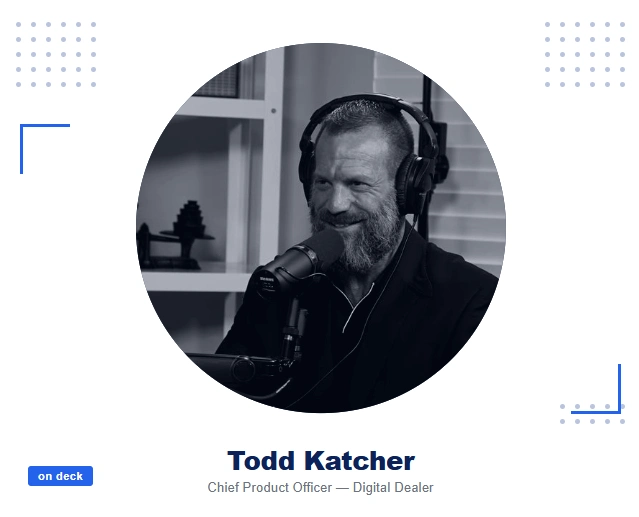
Episode 103 Todd Katcher


LISTEN OR WATCH ON


EPISODE OVERVIEW
KEY TAKEAWAYS


Experience

Connection
EPISODE transcript
Chris Herman: Okay. Hello, everybody. Welcome. Welcome back. It's been a while. It has been—it's been three years. We saw each other at NADA and here we are later in a long time. So it's good to see you. Welcome.
Todd Katcher: It was a nice way to turn the corner and walk into you and be like, you know, you see a lot of people at NADA and oftentimes your brain gets boggled, right? You're like, where do I know them from? What's their name? Do I even like this person? What interactions have I had with them? You know, are they a dealer? Are they a customer? Are they a vendor? And when I saw you, I'm like, "Hey, Chris." And it's like, you know, connection.
Chris Herman: I agree. And I hate to say this, but you know, as the years have passed, sometimes my memory is not as sharp, right? And I've had this happen a couple times where you run into somebody like, "Hey, Chris, how's it going? You remember this specific thing?" And I'm on the back foot sometimes going, "Oh yeah," then it clicks. But you know you feel bad when that happens. But that does not happen when we see each other because I can say I can remember years of walking around whatever conference it would be there. You would be standing in front of all that, but I want to jump right into where we were before we started. So you are—it seems to me that you are a self-proclaimed perfectionist?
Todd Katcher: I would say that I really try to balance that ideally and the criteria that I hold myself to for products that we put out to the market. There's multiple ways of doing that. So my learning—I have my own criteria of what I expect and what my own business is relevant to. I don't say that I'm a perfectionist in a bad way in your own world and the people around you in the studio interact with the dealers that we interact with and other people, how they live for them and what's my owner and who I want in my life. So it's not like that. I don't really want to live up to—it's not so—I think the problem with perfectionism is when you try to push it down everyone else and have that expectation. They all have their own history. And so what they have ultimately is happiness and joy and their perfection. And so on a deeper level, that's really how I look at it. So when I'm creating content, we're creating products or we're creating software, whatever that is, I have a vision but I also have a team and I'm not always right. So I try to achieve a certain level of what's acceptable, but I also don't go and say this is the perfect way of doing it because essentially what we're talking about is attention to some people that I share the same way to most people, which I understand, but for me I go through the world—I like to have things in my world kind of messy, you know, that's my way. That's how I choose not to be insistent on things as you found. And I'm a founder and so you recognize that you can't be the founder forever, right? If you're going to operate that way, you have to start to get out of your own way to really recognize that there are people in the world that are a compliment. That's what I want. I, in this world of trying to grow a business, you want to be surrounded by people who share the vision. It's better because not coming out and—what they used to say, right? It's more we share our ideas and then ultimately make a lot of time. So we'll have a meeting with three or four people in our office about something or something new and I'll say, "What do you think about this?" and have them do a demo and then come back to me and say, "What was your experience?" And we have different programmers to support people and the utility of it.
Chris Herman: And so your target market?
Todd Katcher: So if you're trying to create something that's intuitive and somebody who doesn't have a technology background—the keys, right—would they be able to operate systems? Afterwards, are you going to receive—right? And so like if we create it for the tech, that's a different skill set that's required—barrier to understand when you look at your software, how easy to navigate and how easy it comes fast and how much thought process. How many times do they want to call that helpline, right, to go ahead and solve that process? We make it so easy. I was just listening to a book and one of the things they were making a minimal amount of money through their online shopping. But the idea is that you get to the point once they got less clicks and completed all the steps because they made it for the tech person who had the time and they brought it down to simple.
Chris Herman: So before we get too—I know there's a bunch and I started programming so I keep on coming up with new ways to solve problems on my own. So, but we'll focus on the main ones. So we met through Digital Dealership System which is leaderboard digital science for the auto industry?
Todd Katcher: From the start to now—exact at that time when I started it was in Nashville and I owned three bars at that time and it was a side project that ventured into a network that I had where we had screens in bars and restaurants and I thought that was my goal to go ahead and build that network as well. One of our customers at their dealership wound up and I said, "What would you want to do from that business?" And so that's where the requirements have changed significantly. So about five years ago we started to create our own software company and then we've been using that internally for our thousand plus media players installed over time or less. And so we actually have developed our own software that we are now going to market which is digital signage and we made it as advanced as possible to meet the needs of every type of business in the market—pricing structure or whatever.
Chris Herman: So to clarify a little bit of the reason talking earlier gives you the opportunity—it's been years and how are most dealerships utilizing that?
Todd Katcher: Yeah. So when we started we had the leader board but years ago and rebranded and created two different divisions: customer service for car dealers to go ahead and communicate their brand awareness, their service status, their marketing to customers. So just like they spend money on traffic, this is once they're in the dealership—what type of message you want to create? Second division is our leaderboard which stands for the idea of our leaderboards and they've been hugely successful for the company based on the requirements they had. They gravitate more towards it. There's nothing out there. They have the ability to go ahead and use DMS, CRM, third-party tools that cost a huge amount of money, up to $3,000 a month. What's missing is that middleware—is a snapshot experience. An ad—and they create some sort of creative or some sort of—what would you call it? What's your plan? A campaign or strategy. Yeah. And you implement that and then you evaluate your frontline workers: your advisors, your technicians, your sales staff. But they want to know about how can I increase my sales to go ahead and make more money. That's where they receive the rewards of their efforts. And so our leaderboards focus specifically on them with text messages when a deal happens or you look at your performance. Units or trades that you do, sourcing directly from the CRM, texts, emails, how many appointments you're setting, all that. So, a report is great on a small desktop for managers, but your frontline workers, they care about their performance and they care about the motivation from their team.
Chris Herman: Where are these typically displayed?
Todd Katcher: In a variety of places in a sales area, but sometimes in a room—it's not out on the floor where customers see it, right? There are some stores that have sales manager towers out on the sales floor and they'll put our system on there, but they choose what KPI leaderboard shows up there. They know people walking in know they sell cars, right? So, showing units is not a bad thing. Showing your goals on units isn't a bad thing. You wouldn't want to show certain things and actually one of our reports shows average deal, right? You know, who's on top of the list has the highest average. Like I don't want that guy over the most amount of money or the most money trades. It's also feedback, you know, does it end up being a good motivator? Because you know if you're on the leader board, it works as a potential motivator.
Chris Herman: So you know coming into the digital age, even if you just had that one leaderboard there it would increase the likelihood of success. Now you have a little competition—let's say the top three people might change as a little bit—like, oh, got a sitting smoker at 8:30 or 9:00 in the morning, whatever time it is, and there's people outside. Imagine if you're outside that might change?
Todd Katcher: We have some big stores that utilize our system as well because whenever that happens, everybody congratulates each person on top. Just because you sold the most amount of units may not mean you're the top. So somebody who's top on your leader board—maybe their goal is 10 a month. So they may be different. So that provides motivation for the people that may not be the top—personable leader order, whether that's trades or whatever. Or a coach about $10,000—a new person reaches that, they are aware that their goal is to focus on the top.
Chris Herman: And restaurant and sort of accidentally ending up being one of a provider of customers where you obviously in your experience working—now you've gone to a performance tool. It's a very interesting transition. So in terms of how do they see you? Who are you to them? Are you a guy that sells them video or are you now more than that performance?
Todd Katcher: So originally when you look at things—it's true that the service manager said, "Hey, I want to add I see a lot of value added." As marketing got the concept right when they come in their name to market all his concepts. What we've learned is that dealers often go ahead and look at the actual operations of their store. Spend a lot of money on tools and back operations. And so those people that are more on the cutting edge of that area see the middleware of a leaderboard and then they choose whether or not to deal for what the value is in that. But it's a good value.
Chris Herman: There's lots of places where a negative example they would invest in a service—investing to what do or are you still—the reason I'm asking that because you're talking a lot more about performance than you are about the actual product. So how do they—do they have—see that in you?
Todd Katcher: Um, I think our product line—but they do ask, "How do we set our goals? How do we do this thing?" I love it. So to answer your question, they really—I used to work for a guy long—a lot of dealers come in like "we got this"—reaffirms the facility where they see the value and that's really a lot of the conversations now have been more "we get more" general dealership, but it's not a priority for ownership. It's more of a service director or GM would use the word customer experience.
Chris Herman: Do you think dealerships—like they're not—there's a difference and you know how many people say "I do it because it's not the person that goes to McDonald's." Dealers invest in more nutritious food at home in less time.
Todd Katcher: So the opportunity that's different customers—customer. If you want to buy a Ford or you want to buy a Toyota or you want to buy a Honda, there's five different experience that makes that person come back. And that's where I believe—let's go ahead and assume that every service—we're not talking well and they all hire the best. They all train them the best they can. They all have uniforms. They all have their criteria right through the service. You're going to have a service menu. We've actually had some dealers because every customer.
Chris Herman: Okay. So, I agree and I would say that what you're talking is there is a tool, a technology or a thing that is going to create the experience. So what you're talking about to music are the—does it feel part of the retail experience though? Forget the human component which is not only did you hire the right people but how you treat them. How do you interact with them? How do you deal with each other in a stressful performance environment that still results in people being pleasant to the customer, right? We've all been to the amazing "wow" place where the people were—and at the end of the day all the "wow" rarely overcomes the shitty experience that you know. We talk a lot about what does your brand mean. You know, we all think that our brand is the story, right? But really, the brand is the experience of interacting with us. So, I think that when we're talking about any business, we have all these great tools and technology—of you as well, dealers are relying on your team.
Todd Katcher: Yeah. And I want you to normalize that I look at it beyond that, right? So I think in the customer experience is how do you make your store different because as much as when we go visit a dealership we're there for a very limited amount of time. So our goal is to improve their entire dealership. We're going in there to provide customer experience through that journey. To maybe—the nicest guy, but they had these signs up there and they let me know my vehicle was ready and I'm going to go back there because of that. Because the other guy at the other dealership—they didn't have good people.
Chris Herman: Let's go ahead and just focus on every dealership. Yeah, I think as you look through the customer journey and you look at the service, how are you? How are you pricing? How are you welcoming them in the store? Of course there are. So how do you experience and then why are you showing your competitors? Why are you showing wars, protests, whatever may be on TV? Like there is an actual dealership between two sections and one has CNN and one has a glass and they go ahead and sit in different rooms. Why are you?
Todd Katcher: Use our system—digital signage and leaderboards. Why do you do this? I have a passion for it. Um, I think that what we talked about before we went on air—that I think I see digital signage as not a sex and it's not a business that would be going to go ahead and have like a DMS where they're spending $20,000 to $50,000 per month for your service. So financially it's not the same but I think we can make an impact with digital signage leaderboards and I believe that someone who has a personal trainer would go ahead and get more benefits than on their own. That's why a lot of people work out with partners, right? To push them a little bit more or to make them show up when they don't want to show up, that type of thing. There's a human aspect as well as getting over the hump to invest in that beyond just signing up for the gym membership now is a leap. I enjoy that. That one dealer that you were referring to that wanted their dealership to look like everywhere else—I don't want to invest in any dealership like a big customer might be a month. You can do a full store for $500. It's not a big expense. $500 for a dealership—first of all in their revenue, but on a $500 investment.
Chris Herman: Essentially what you are telling is that you derive a sense of achievement and satisfaction from helping people. That aspect is very?
Todd Katcher: Even going back to high school I was part of leadership groups and part of the type of community that was tied into culture building. And even in college I was part of an association that was to betterment the student body at Ohio State—The Ohio State University. We live in—go ahead and provide structure for them and each state bureaucracy and I think that's always software that some people may accept and I'm like this—bettering little levers of life go to that. So I could only model and that's kind of what I hear backward.
Chris Herman: Now let's fast forward. Where does this company transition?
Todd Katcher: I think there's really my attitude how I—myself—as I've learned. I can say whatever I want, but how is my words? So I don't really look when you say like where does this go right now with hundreds of employees or thousands of—part of that partnership. I think there to be part of a larger experience, right? And ultimately you're talking—let's say that software. Yeah. You know, when I was younger, I created my first business and I had that challenge with like how far ahead and you realize that none of that ever happens. There's too many others. So whether it's business or—but it's very—like I'm very certain that certain things in my schedule that I want to do. But then I also look at last year on a personal level in January. So I went ahead and backed everything—like everything was done including like I planned it out ahead of time and I just did everything. But there's too many other organizers. I would be surrounded by people sometimes rotating my office. So in general I really want to focus on taking care of those situations. I also understand that if we were part of a larger organization—part of a larger.
Chris Herman: No, I think that we've been approached by companies and I've always said, "What is our acquisition?" and we turned down a lot of money. How are you going to say yes? What is the next step? And if they don't have the right answer, then they don't want me involved. That's an easier solution, right? Here's your money and just walk away. But they've all asked me to be involved. So if I'm going to be involved, there has to be some sort of—you need to help because we're growing a lot. So we sign up new dealers. We have growing as you've spoken to already. They already called their big customers about this product.
Todd Katcher: So when you look at those big companies, the challenge is we're—I'm always from my perspective. I heard about those terms. So you're turning some—sad guess it's—I had a conversation with a dealer the other day who said, "Oh, I used to use that program and then it was acquired by XYZ company and then I cancelled because it just wasn't—I couldn't get support after ever since." They mix down the product because nobody's actually the people that are making it aren't—so I was reading and this is what he's part of—Lululemon's board. Most of these people that are running these in the automotive space have been so far removed from the automotive experience—they're not able to make quality decisions based on that experience. They're running a business but they're not there at the point of things and it's inevitable. Oh, I saw that the product here. I don't even know how to hold a bite. I mean, it literally looked like he was afraid to let his lips touch now. Whether they did—some people thought they did that intentionally just to get a bunch of people fired up. It's not a good look, but it's so representative of how companies get larger and larger and larger. Not only people—just get so far away from the human that's going to be focused as long as I can possibly find a way to continue whatever it is.
Chris Herman: I'm thinking about changing my website. Let everybody know how are you changing your website in these days of hopes that this is going to make a big difference in your business or spending a little bit more time in the business. Go and see your bathroom. Kind of use this as a little bit of summary because you're offering great solutions to dealers and business owners involved in what it's. We all think there's no slowdowns, you know. And so I applaud you because you're growing your business. You're thoughtful. You're passionate about what you do. And at the same time, you know, we don't need—so, we're in a good position because the business—I started this business when I had 10 TVs extra on a wall in my extra bedroom that I while sitting on the floor. I would build computers myself, you know. So like it's like—and I've always walked and I have a memory. So it is a passion because I wouldn't remember these things if I wasn't fitness.
LISTEN OR WATCH ON
EPISODE DETAILS
TOPICS COVERED
SHARE THIS EPISODE
MORE EPISODES YOU’LL LOVE